

More Reasoning Levels for Sol, Terra, and Luna Check Run AgentsCheck Run Agents now support
xhigh and max reasoning for gpt-5-6-sol, gpt-5-6-terra, and gpt-5-6-luna. Learn more about Check Run Agent models and pricing.Turn a Review Feature Completely Off with Feature SwitchesA new Feature Switches section at the top of Settings → Repos lets you switch Correctness, Approvability, and Check Run Agents off outright. A feature switched off does not run at all: no
@macroscope mention, always-review label, or personal setting can start it. Set it for one repo, under Defaults for newly linked repos, or across several repos at once.New incremental Input Mode for Check Run AgentsCheck Run Agents have a new incremental input mode, and it is now the default. In this mode, when you push additional commits to a PR, the agent reviews only the files changed in that push, instead of every file changed by the PR (the same way correctness review works).GPT-6 Astra Support in Check Run AgentsCheck Run Agents now support gpt-6-astra, a flagship model with a large context window and reasoning at low, medium, high, xhigh, and max — it is the only model that accepts max. Learn more about Check Run Agent models and pricing.Run Correctness Review After Your CI, or Only When It’s GreenCorrectness review can now wait for your CI steps before it starts, and skip entirely unless they passed. Set
waitsFor, requires, waitsForTimeout, and waitsForDiscoveryTimeout in .macroscope/correctness/correctness.md — the governing file for the whole correctness check, alongside your other instruction files, which keep their own include/exclude patterns. Learn more.Check Run Agents Now Know What Has Already Been Said on Your Pull RequestA Check Run Agent now starts every run already holding the pull request’s discussion. You do not have to write instructions telling it to go and read the comments, and it spends no tool calls or tokens fetching them. Learn more.Expanding Detection Mode: More Control Over Every ReviewWe’ve expanded Macroscope Detection Mode, giving you more control over how each code review balances recall, precision, latency, and cost. Now, you can select the ideal performance profile for each review:
- Ultra ($0.20/KB): Frontier bug detection for the most consequential reviews.
- Balanced ($0.05/KB, default): Industry leading high bug detection.
- Precise ($0.06/KB): Balanced-level detection with higher-confidence findings, using extra agentic validation to reduce false positives and low-value noise.
- Budget ($0.025/KB): Fast, low cost bug detection.
alwaysApproveApprovability has a new alwaysApprove key in the front matter of .macroscope/approvability.md. List glob patterns there — lockfiles, vendored dependencies, generated code — and a PR whose files all match is approved on eligibility without running the agent, so the run is free. It is all-or-nothing: one file outside the list and the PR goes to the agent as usual. It skips the agent, not the rest of approval — correctness findings, the repo’s approval setting, and every prerequisite wait still apply — and it never overrides neverApprove or the always-on protection on your approvability file. Learn more.GLM-5.3 support in Check Run AgentsCheck Run Agents now support glm-5-3, a large-context model with configurable reasoning levels. Learn more about Check Run Agent models and pricing.Give a Late-Publishing Check Longer to Appear with waitsForDiscoveryTimeoutCheck Run Agents and Approvability now supportwaitsForDiscoveryTimeout , which gives conditionally published prerequisites — like checks behind earlier jobs or queued workflows — longer to appear before they are treated as absent. It supports 1–60 minutes; named prerequisites stop waiting once found, while waitsFor: ["*"] waits the full floor on every run and shows a warning.Skip PRs by Author Now Covers Every TriggerAccounts listed under Settings → Repos → Pull Requests → Skip PRs by Author now have their PRs skipped across correctness review, Check Run Agents, and Approvability.Config Changes Now Take Effect in Your PR, No Merge RequiredFiles in
.macroscope/ are now read from the most recent commit on the pull request rather than from your default branch, so a config change takes effect in the PR that makes it. This covers Check Run Agents (.macroscope/check-run-agents/), ignore rules (.macroscope/ignore.md), and correctness review custom instructions (.macroscope/correctness/), along with any file they import with @path.DeepSeek V4 Pro Support in Check Run AgentsCheck Run Agents now support deepseek-v4-pro (DeepSeek V4 Pro), a large-context model with binary reasoning. Learn more about Check Run Agent models and pricing.Gate a Check Run Agent on Its Prerequisites with requiresCheck Run Agents have a new requires key option in front matter. Where waitsFor only controls ordering — any conclusion satisfies it — requires also gates on the outcome: the agent waits the same way, then runs only if every prerequisite passed. Learn more.New Correctness Review Setting: Minimum Severity to CommentA new control in Settings → Repos sets how severe a correctness finding must be before Macroscope comments on it: Low, Medium, High, Critical, or Off. The default is Off, which posts everything. Available per repo, across several at once, under Defaults, and as a personal floor in Settings → Personal.New Models in Check Run AgentsCheck Run Agents now support:
grok-4-6 (xAI Grok 4.6) and qwen-3-8-max (Qwen3.8-Max), both with reasoning effort up to xhigh. Learn more about Check Run Agent models and pricing.Ignore Files in Macroscope CLI ReviewsMacroscope CLI reviews now honor your repository’s .macroscope/ignore.md file. Ignored files are skipped from review, and Macroscope’s built-in defaults (vendored dependencies, generated code, binaries, and test files) apply when a repo has no ignore file. Learn more.Protect Paths from Auto-Approval with neverApproveApprovability has a new neverApprove key in the front matter of .macroscope/approvability.md. List glob patterns there and any PR touching a matching path will never get approval from approvability check. Learn more.Daily Chart View for Agent Credit UsageThe Agent Usage Detail section in the Billing Dashboard has a new Daily chart view alongside the pie chart. It plots agent credit usage per day, grouped by type, repo, or Check Run Agent, and you can select any slice to see that series on its own with its run count, totals, and per-run cost range.New Correctness Review Settings: Limit by Run Count and File SizeTwo new per-repo controls in Settings → Repos let you bound how many correctness review invocations a single PR can trigger and how large a file Macroscope will review:
- Max Automatic Reviews caps how many times correctness review runs automatically on one PR: once the cap is reached the check concludes as
skipped, titled “Maximum runs reached”, with a summary referencing your limit. Manually triggered reviews, check re-runs, and moving a PR from draft to ready are exempt. - Max File Size skips files larger than the configured KB limit when reviewing for correctness; useful for repos with large generated or vendored files. Larger files are listed on the check run with the reason “File too large (exceeds configured limit).” Glob-based excludes in
.macroscope/ignore.mdstill work; this adds a size-based option.
ignoreTests: false front-matter block to the top of your .macroscope/ignore.md, and Macroscope will review the repo’s test files as it would any other code.Spend Limits for Check Run AgentsYou can set maxBudgetPerRun in a Check Run Agent’s front matter to cap what a single run of that agent may spend (in US dollars). The agent checks its accumulated cost after each turn and stops once it reaches the cap, concluding the check as neutral with a “Budget reached” message.Referencing Other Files in Check Run Agent InstructionsCheck Run Agent instructions can now embed other files from your repository with @path/to/file.md, so you can pull existing docs and context into an agent’s instructions.New Models in Check Run AgentsCheck Run Agents now support Kimi K3. K3 delivers performance rivaling top frontier closed models, at a fraction of the price of Fable 5 or GPT-5.6 Sol. Check Run Agents also now support Claude Opus 5. Learn more about Check Run Agent models and pricing.Lower Check Run Agent Model Pricing for GPT-5.6 Terra and LunaWe’ve reduced Check Run Agent pricing for two GPT-5.6 models:
gpt-5-6-luna is now $0.20 per 1M input tokens and $1.20 per 1M output tokens, and gpt-5-6-terra is now $2.00 and $12.00. See the full pricing table.Screen Recordings in Slack Commit SummariesScreen recordings attached to a PR — in the description or a comment — now appear in that commit’s Slack summary thread, alongside the images Macroscope already posts, so your team can review visual PR context without leaving Slack.Faster, More Accurate Code ReviewWe’ve shipped a major update to Code Review that makes reviews faster and better at finding bugs: up to 20% lower latency on average and up to 20% better recall, depending on your Detection Mode setting.Bug Grouping in Review CommentsWe’ve improved how findings are surfaced in PR comments:
- Critical and High severity bugs are now separated from related lower-severity findings.
- Related findings are grouped more accurately.
macroscope with no arguments for a guided setup wizard. You can also run Macroscope from inside Claude Code, Codex, Cursor, and OpenCode using the agent plugin installed alongside the CLI.Read more on the blog.Code Review ImprovementsWe’ve made several improvements to our code review pipeline, particularly for Go, Rust, and Python.Run Limits for Check Run AgentsYou can now set
maxRuns in a Check Run Agent’s front matter to cap how many times it runs on a single pull request. Once the cap is reached, later pushes conclude the check as skipped with a “Maximum runs reached” message instead of running the agent — commenting @macroscope review still runs it past the cap. Learn more.Adjust Billing Chart Date RangeYou can now drag across the usage chart in Billing to select a date range within the billing period. The usage tables and totals update to reflect just the selected range.Code Review Improvements for Swift and RustWe’ve made improvements to our code review pipeline for Swift and Rust, helping Macroscope catch more idiomatic issues in those languages.Open-Source Models in Check Run AgentsCheck Run Agents now support
kimi-k2-7-code, glm-5-2, minimax-m3, and qwen-3-7-plus. Learn more about Check Run Agent models and pricing.GPT-5.6 Models in Check Run AgentsCheck Run Agents now support GPT-5.6 Sol, Terra, and Luna.Run Filters for Check Run AgentsYou can now configure Check Run Agents to run only on specific PRs via runFilters in the front matter. Use the labels, authors, and targets fields to scope CRA to PRs that carry a specific label, come from a specific author, or target a specific branch.PR Metadata Input Mode for Check Run AgentsCheck Run Agents now support input: pr_metadata : a new mode for reviewing a PR’s title, author, description, labels, and commit messages instead of the code diff. This is useful for checks that enforce PR conventions, ticket requirements, or metadata standards.Required Status Checks for Check Run AgentsYou can now set requiredStatusCheck: true on a Check Run Agent so it always reports a conclusion, even when its include, exclude, or applicability filters skip a PR. Skipped runs report as skipped, which GitHub branch protection treats as passing, so the agent can be used as a required status check without blocking unrelated PRs.Improved Cache Hits for Check Run AgentsWe’ve improved cache hit rates for Check Run Agents to help you save on costs. Unchanged runs are now more likely to return cached results (e.g. after a rebase) so you don’t pay to recompute the same review.Check Run Agent Filters Override Soft ExclusionsCheck Run Agent include and exclude patterns now override Macroscope’s default soft exclusion patterns, so your CRA runs on exactly the files you’ve configured. The same override applies to custom correctness instruction include and exclude patterns.Check Run Agent Usage Breakdown TableSettings → Billing now has a Check Run Agents section that breaks down your workspace’s spend and usage over a billing period. The top row summarizes active agents, total runs, total credits consumed, and total cost. Below it, a table breaks that down per agent: repo, total runs, credits consumed, cost, per-run avg/min/max cost, and the last PR each agent ran on.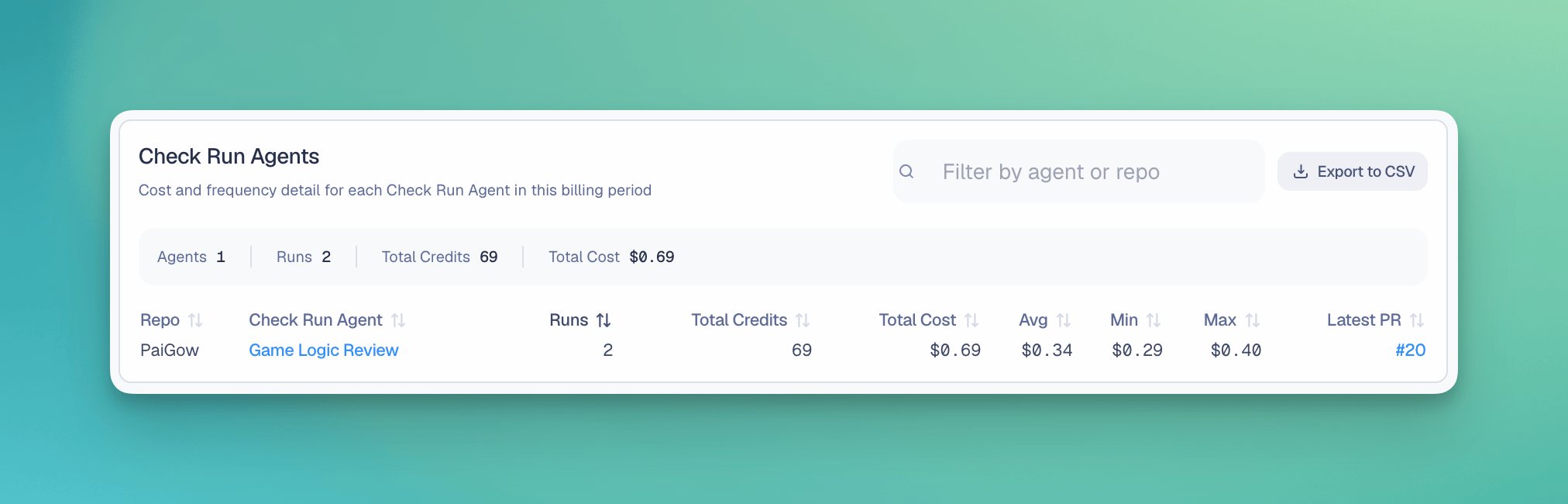
fable-5 and claude-sonnet-5. Learn more.New Code Review PipelineWe’ve released a new version of Code Review that finds substantially more bugs. In our benchmarks it surfaces: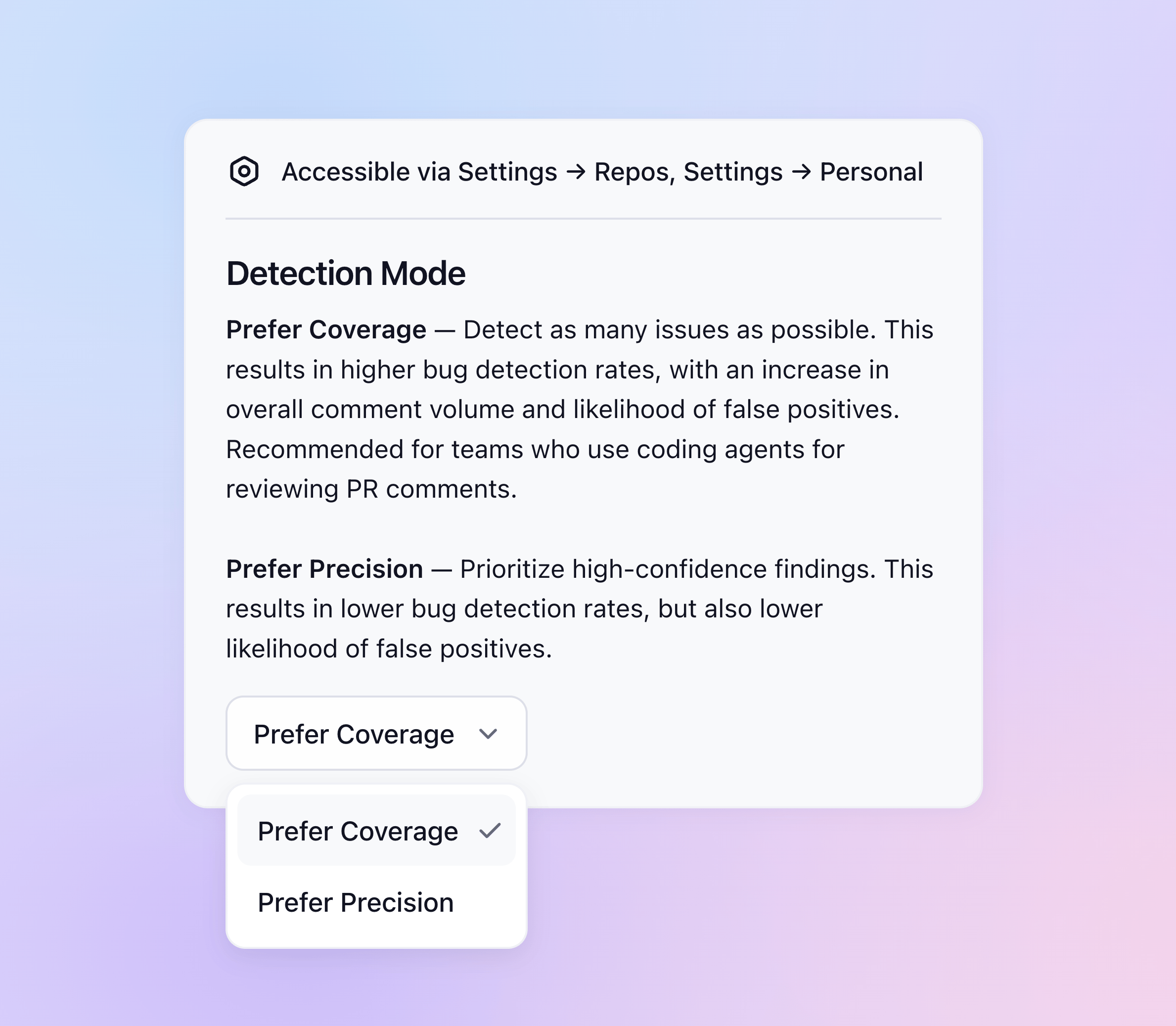
- 71% more critical issues
- 27% more high-severity issues
- 50% more medium-severity issues
- 31% more valid issues overall
- Prefer Coverage (default) — maximizes detection, with higher comment volume and more false positives. Built for teams using coding agents to validate PR comments.
- Prefer Precision — prioritizes high-confidence findings: fewer bugs caught, but fewer false positives. Mirrors the experience of the past few months.
.macroscope/check-run-agents/, so teams can organize their configuration files into subfolders.Manual Review Links to Check RunsWhen you manually trigger a review with @macroscope review, Macroscope now posts a link from the PR thread to the generated check run.Improved Python Code UnderstandingWe’ve improved our Python codewalker to follow imports, type hints, class relationships, and nearby dependencies more accurately during review.Personal MCP ConnectionsYou can now connect your own MCP servers as personal connections from Settings → Personal. These connections are separate from the MCP connections admins can set up for their workspace. Macroscope can use those personal connections on your behalf when answering your questions in Slack. Learn more about MCP Connectors.Skip Automatic Reviews by AuthorWorkspace admins can now skip automatic Code Review for specific GitHub authors under Settings → Repos → Pull Requests → Skip PRs by Author.Default View for the Commits FeedYou can now save your preferred filters as the default view for your commits feed.Slack Agent ImprovementsWe’ve made several improvements to how Macroscope’s agent answers questions in Slack, including:
- Live “Thinking…” status. When you @ mention Macroscope, a native status indicator appears on the thread while it works, then clears when the answer posts.
- Native tables. Tabular answers render as tables instead of plain text.
- Clickable links. Links render as clickable labels instead of bare URLs.
Landed vs. Pushed Coding TimeProductivity stats now separate pushed coding time (everything authored and pushed to git) from landed coding time (the portion that merged to your default branch), so you can see not just how much code was written but how much actually shipped. Available with Status enabled, with rollups at the organization, team, engineer, and agent level. Read the blog..png?fit=max&auto=format&n=RyCUVg3_pdaHf333&q=85&s=d8a7b52b0e50d9bfa837e06449be5bf2)
jobToken and pollUrl so integrations can trigger long-running agent jobs and poll for completion, rather than waiting for a synchronous response. Learn more about the agent API.Check Run Agent Tool-Call VisibilityA Check Run Agent’s GitHub check run now includes a “Tool Calls” section in the check details, showing what the agent did during its review. Available for workspaces using Check Run Agents.New Code Review PipelineA new code review pipeline is now available, improving overall bug detection by catching 40% more critical issues and 25% more medium severity issues. The tradeoff is slightly lower precision and higher latency, which we’ve found is a worthwhile tradeoff for teams heavily using coding agents in their PR review process.Manage Detection Mode from Settings under workspace defaults or repository pull request review settings.MCP Connector Access ControlsMCP connectors now support per-user access controls. When creating or editing an MCP connection, use the Access tab to define an allow list of users who can use it. Learn more about MCP Connectors.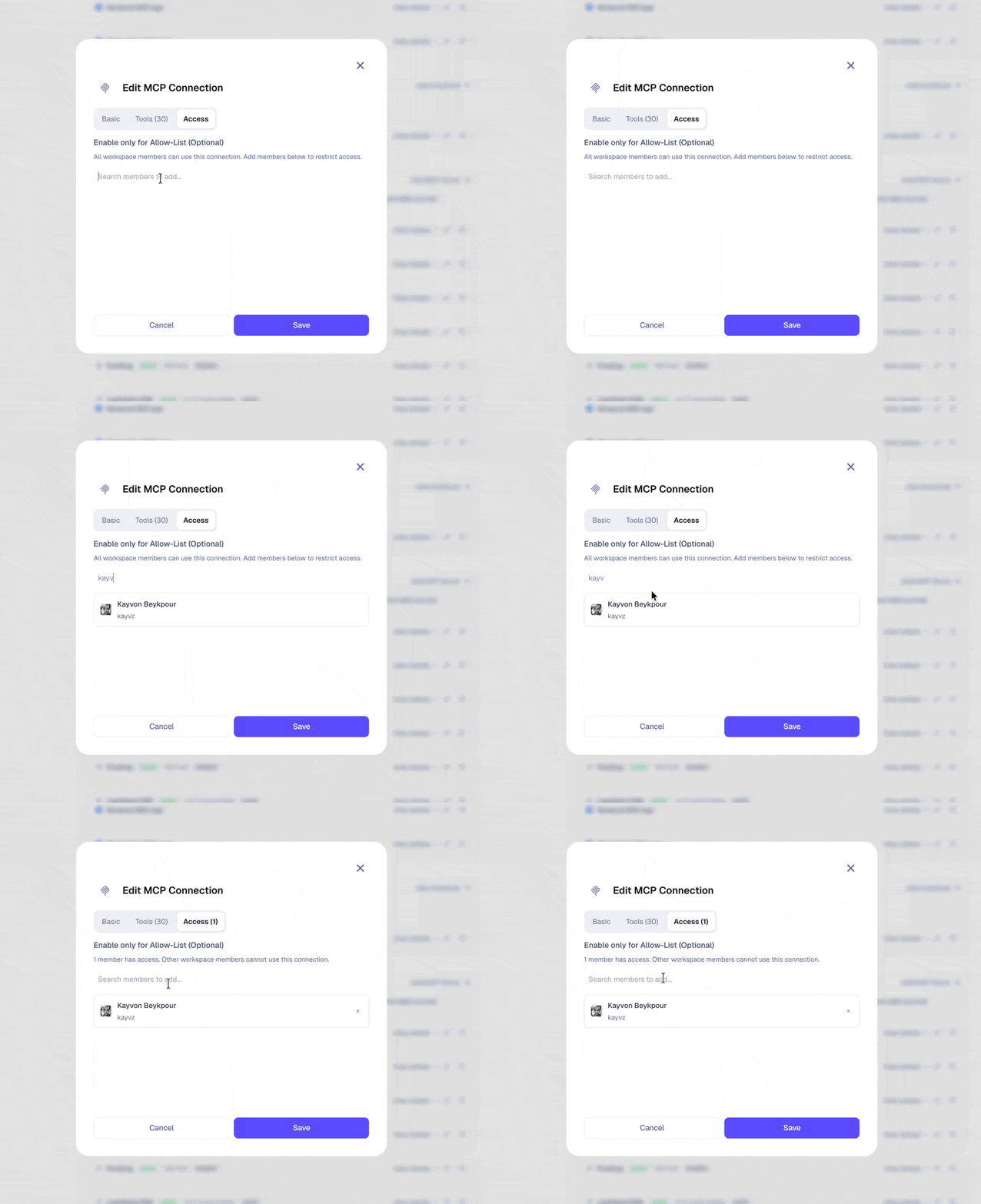
- Explicit feedback covers emoji reactions (i.e. 👍 or 👎) on review comments
- Inferred feedback reflects sentiment Macroscope classifies from replies when a PR is closed.
Check Run Agent Prerequisite StepsCustom Review Agents now support prerequisite CI step gating with the
waitsFor configuration option. Specify CI checks that must complete before a review agent runs—useful for sequencing reviews after builds, tests, or other checks. Configure per-agent prerequisites with optional custom timeouts, or use "*" to wait for all other checks. See Check Run Agents for details.Claude Opus 4.8 for Check Run AgentsClaude Opus 4.8 (claude-opus-4-8) is now available as a model option for Check Run Agents. Set model: claude-opus-4-8 in your agent’s front matter to use the latest Opus generation.Code Review ImprovementsWe’ve made improvements to our code review pipeline, resulting in increased recall for TypeScript, Rust, Swift, Kotlin, JavaScript, Python, Java, and Go.
Exclude GitHub Authors from Commit ProcessingAdmins can exclude specific GitHub authors from commit summarization and productivity metrics (i.e. Status features). Manage the list under Settings → Workspace → Excluded Commit Authors.Check Run Cost VisibilityCheck Run Agents display their billed total directly in the GitHub Checks tab, so you can see the cost of each run.Slack Connection RefreshAdmins can reconnect their Slack workspace from Settings → Connections to reauthorize new OAuth scopes. Use this whenever we add new bot capabilities and you want your existing connection to pick them up without uninstalling.Code Review ImprovementsWe’ve made improvements to our code review pipeline, resulting in increased precision and recall for Go.
Macroscope CLIYou can now run Macroscope code review locally from your terminal, against your branch changes before you push. Learn more about the CLI.New Models in Check Run AgentsCheck Run Agents now supports four additional models:
claude-sonnet-4-5, claude-sonnet-4-6, gpt-5-4, and gpt-5-5 — alongside the existing Opus 4.5 / 4.6 / 4.7 and GPT-5.2 options. Learn more about Check Run Agents.Code Review ImprovementsWe’ve made improvements to our code review pipeline, resulting in increased recall for Python and Elixir.Check Run Agents: now GA!Check Run Agents are fully customizable AI agents that execute as GitHub Check Runs on your pull requests. For each Check Run Agent, you can define exactly what the agent checks, which files it should/shouldn’t review, which tools it can use, what actions it should take, and how it formats its output — all from a markdown file in your
.macroscope/ directory. Learn more in our docs and check out our video about it.Delegated AdminsWorkspace admins can now delegate admin permissions to other members from Settings → Macroscope Access → Members. Delegated admins can manage Macroscope settings on behalf of the workspace. GitHub roles and permissions are unaffected.One-Time Credit PurchaseAdmins on usage based billing can make one-time credit purchases from Settings → Billing.
Check Run AgentsCheck Run Agents are fully customizable AI agents that execute as GitHub Check Runs on every pull request. They have full access to your codebase, git history, and connected integrations. You can define exactly what an agent checks, which files it reviews, which tools it can use, what actions it can take, and how it formats its output — all from a markdown file in your
.macroscope/ directory. Learn more in our docs.Code Review ImprovementsWe’ve made improvements to our code review pipeline, resulting in increased recall for Kotlin and Swift.Event-Driven MacrosMacros can now trigger on new commits and new pull requests, in addition to recurring schedules. Configure repo and branch filters to control which events run your Macro. Results can be delivered to Slack or forwarded to a webhook URL.New IntegrationsWe’ve added several new integrations, including Amplitude, Sentry, and GCP Cloud Logging. You can configure your integrations in Settings → Connections. Learn more about supported integrations in our docs.Image GenerationThe Macroscope Agent can now generate images on demand, including architecture diagrams, flowcharts, and visual explanations.Code Review Filter PersistenceFilters in the Code Review activity log now persist in the URL. Copy the link to share a filtered view with your team.New Code Review Settings“Review Draft PRs” and “Automatically merge Macroscope’s PRs” can now be configured at the workspace and repo level. Admins can set organization-wide defaults and manage settings in batch across repos; contributors can override in their account settings.
MCP Connector SupportMacroscope’s Agent can now connect to any MCP (Model Context Protocol) compatible server, so you can give it access to tools like Datadog, PagerDuty, or your own internal APIs. Macroscope auto-discovers available tools and supports OAuth 2.1 and header-based auth. Learn more.WebhooksYou can now trigger Macroscope’s Agent programmatically via webhooks. Send a query over HTTP and specify where to deliver the results: a Slack channel or an external URL. Note: using Webhooks requires Status to be enabled. Learn more.Cross-Repo PR ReviewsMacroscope can now review pull requests where the head branch and base branch are in different repositories. Enable per repo with the new Review Cross-Repo PRs toggle in Settings → Repos.
Ask Macroscope Anything: GitHub API + Docs SearchAMA can now query the GitHub REST API for live data on PRs, issues, check runs, and deployments. Ask “what checks failed on PR #42?” or “show me the latest deployment” and get real-time answers. The agent can also search Macroscope’s help docs to answer any product questions.Code Review ImprovementsWe’ve made improvements to our code review pipeline, resulting in increased recall for Rust and TypeScript.
Next Scheduled Run for MacrosMacros now show when they’ll next run. The next run time appears in the macro header and as a tooltip on the cadence pill, so you always know when to expect your next scheduled report.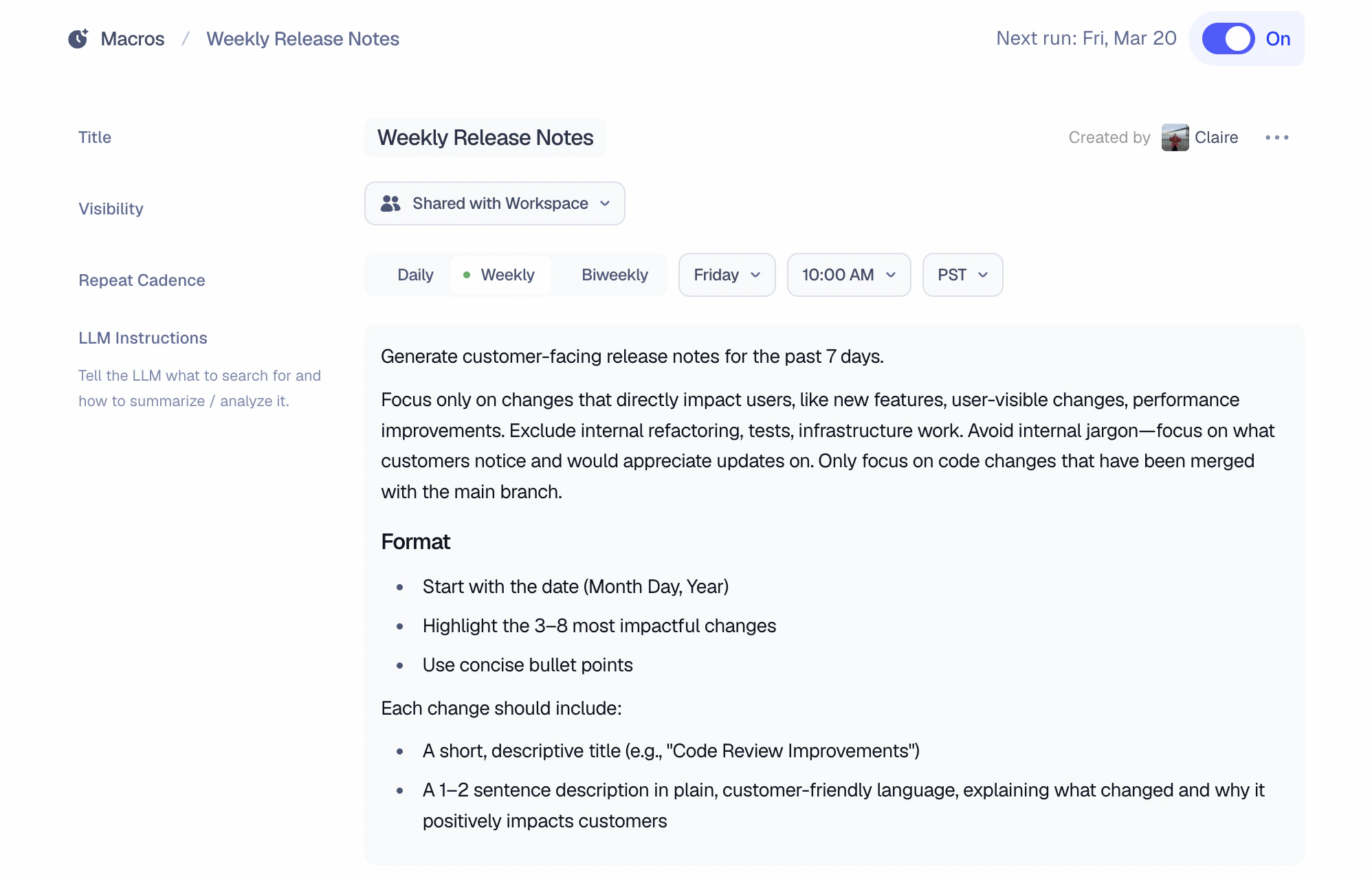
Approvability — Now Generally AvailableApprovability has graduated from beta and is available to all workspaces. Approvability lets Macroscope automatically approve low-risk PRs from trusted authors when they pass code review with zero issues — freeing engineers from rubber-stamping routine changes. Enable it in Settings under the Code Review section. Learn more about Approvability.Slack Group DMsYou can now create a Slack group DM that includes Macroscope alongside your teammates, so you can collaborate with Macroscope outside of a channel.Ask Macroscope to Add PR ReviewersYou can ask Macroscope to assign a reviewer to any pull request directly from Slack — just tell it who to add and to which PR.Per-File Exclusion Reasons in Check RunsCheck run details now surface per-file exclusion reasons, showing why specific files were skipped during review.Code Review ImprovementsWe’ve made improvements to our code review pipeline, resulting in increases in precision for Elixir, Starlark, and PHP, as well as increased recall for Python, Rust, Java, JavaScript, Swift, Kotlin, and PHP.
Biweekly Macro CadenceMacros now support a Biweekly schedule (i.e. every other week) in addition to Daily and Weekly.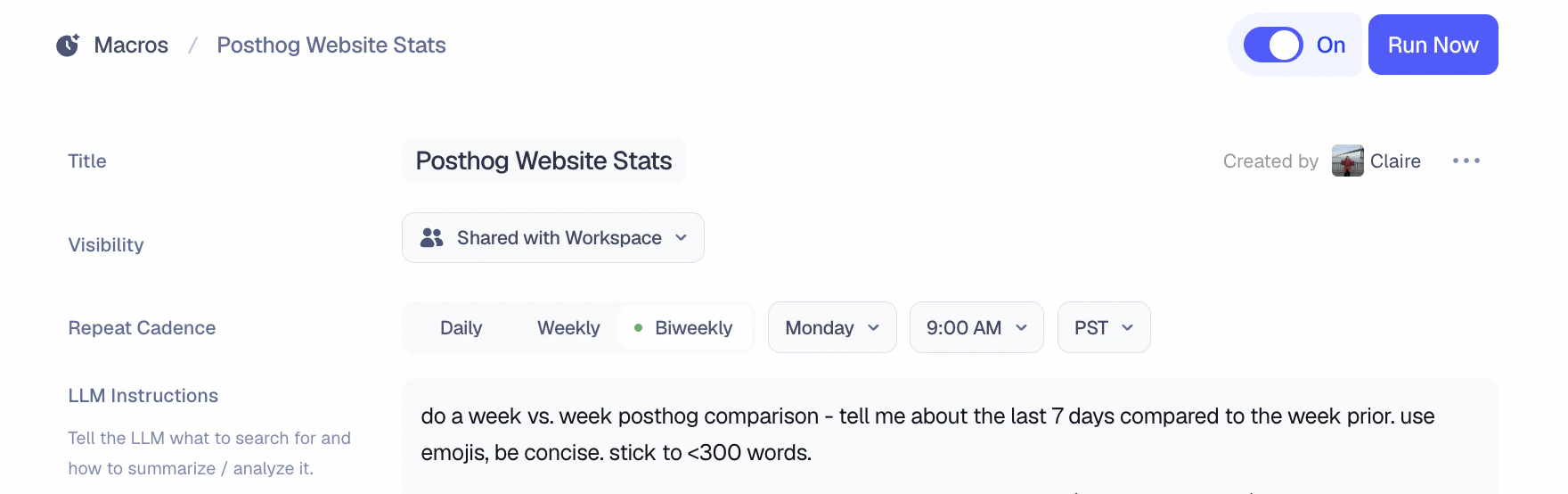
WebhooksYou can now trigger Macroscope queries from external services like Zapier, n8n, or your own APIs. Pass in a query and a destination (either a Slack channel ID or forwarding URL), and Macroscope will post the result to the provided destination. You can create webhooks and see detailed instructions in Settings → Connections → Webhooks.PostHog IntegrationMacroscope now connects to PostHog as a data source. With this connection, you can query your PostHog event data, run HogQL queries, and explore feature flags directly through Macroscope. Connect PostHog in Settings → Connections → PostHog.Always-Review PR LabelsYou can now add “always-review” labels to have Macroscope review any PR, even on repositories where automatic reviews are turned off. This also overrides skip-review labels. Go to Settings → Code Review → Always Review PR Labels to add a label (e.g.,
macroscope-review), then apply it to any PR on GitHub to trigger a review.Slack Attachment SupportMacroscope now reads attachments from all messages in a Slack thread, including images, text documents, and code snippets. For example, you can tag @Macroscope in a thread with a screenshot of a bug and it can parse the attachment and open a PR with a fix.Code Review ImprovementsWe’ve made improvements to our code review pipeline, resulting in increased recall for Go, Java, Rust, and TypeScript.Filter by PR Status in Code Review DashboardIn the Code Review Dashboard, you can now filter code review issues by the status of the pull request (draft, open, merged, or closed), enabling you to see a more focused list of issues and analyze more specific code review stats.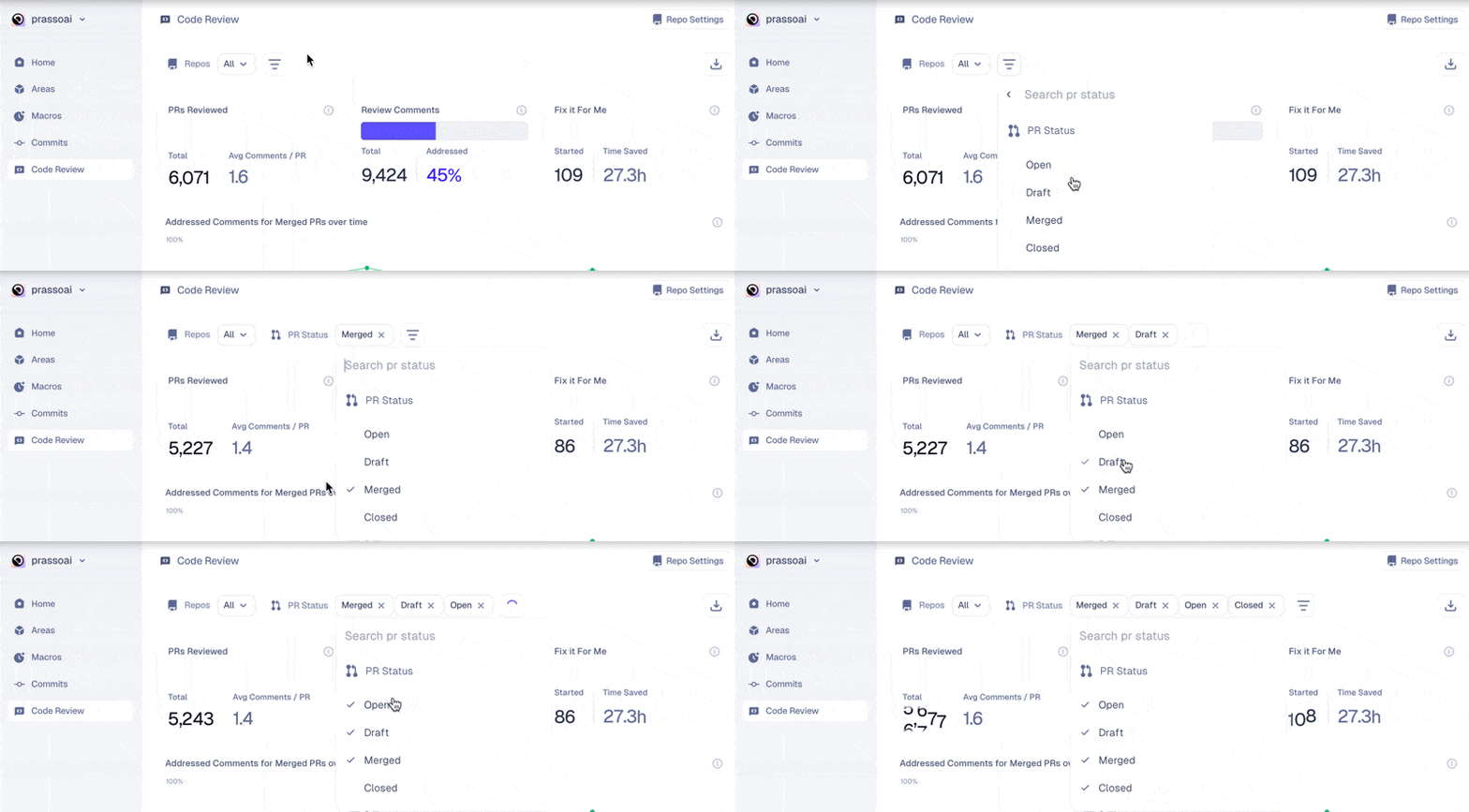
V3 Code ReviewWe released a new version of Macroscope Code Review. Based on our benchmark, v3 leaves 22% fewer comments overall, with 64% fewer nitpicks in Python and 80% fewer in TypeScript, and demonstrates a step-change improvement in precision from 75% to 98%. Learn more on our v3 Code Review blog.Approvability [beta]We’re launching Approvability, which enables Macroscope to automatically approve PRs when low-risk changes from trusted authors meet safety criteria. When a PR is opened or updated, Macroscope runs two automated checks: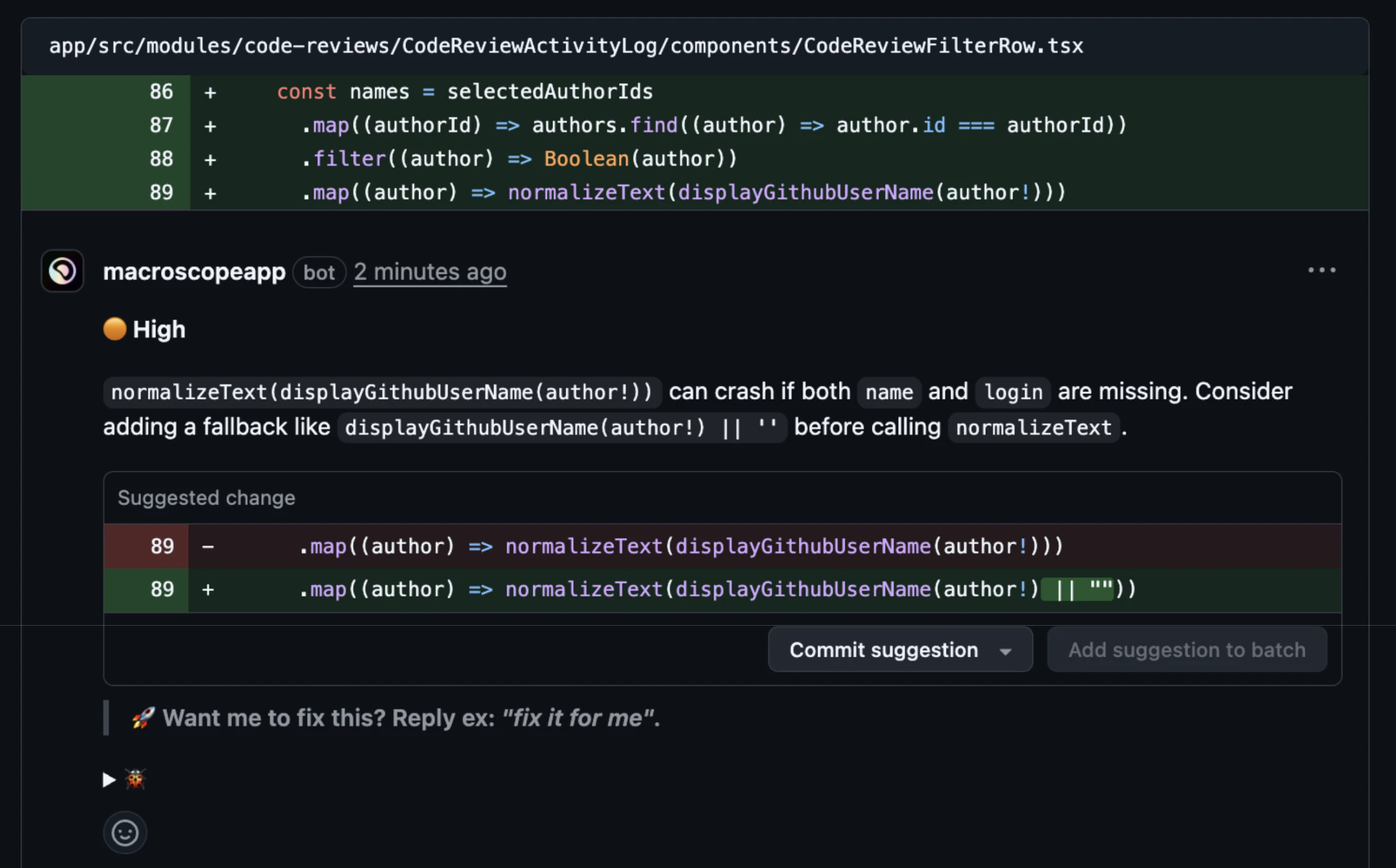
- Eligibility: Do the changes meet your team’s criteria for auto-approval? This includes evaluating code ownership as a contextual signal — factoring in
CODEOWNERS, blame history, and author role. - Correctness : Does the PR pass Macroscope code review with zero issues?
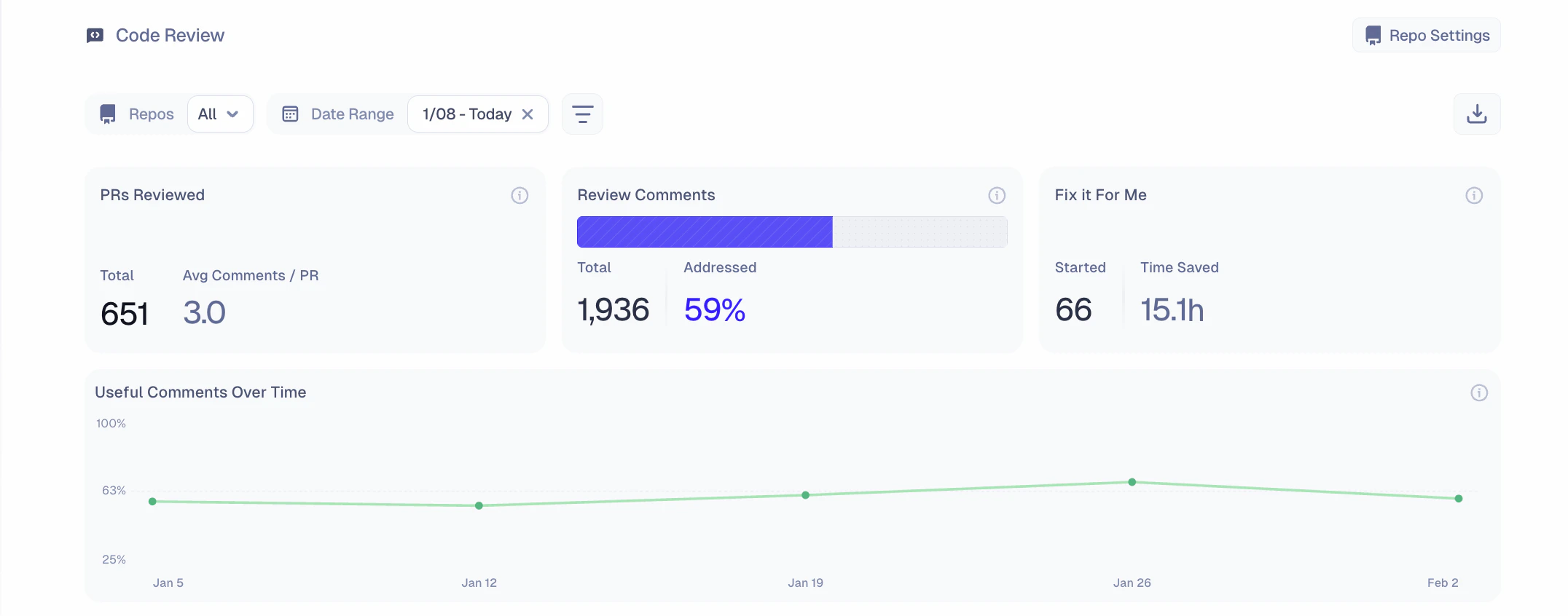
- Filter comments by author, date, feedback reaction (or ), and addressed status (whether a review comment has been resolved).
- View high-level stats, including total PRs reviewed, average issues per PR, total comments left, % comments addressed, fix-it-for-me tasks started, and time saved resulting from fix-it-for-me.
- “Useful Comments Over Time” chart shows the % of review comments that were addressed by PR close or that received positive feedback (from a reaction or a reply).
-
Download your code review history as a CSV.
Linked Issues in Slack Commit SummariesCommit summary notifications in Slack now display linked Linear and Jira tickets when available. You’ll see a “Linked Issues” section with ticket IDs linked to their URLs, making it easier to trace commits back to the work they address.PR Closed NotificationsMacroscope now sends PR closed notifications even when a PR is closed without merging.Code Review ImprovementsWe’ve made improvements to our code review pipeline, resulting in measurable increases in precision for Java, Kotlin, and Swift, as well as increased recall for Python.
Custom AMA InstructionsYou can customize how Macroscope responds to questions about your codebase. Go to Workspace Settings → Custom AMA Instructions to add your instructions, such as preferred response tone, domain-specific context, or output format preferences. You can also define person-specific instructions, like: “customer success teammates should get less technical responses.”Code Review ImprovementsWe’ve made several improvements to our code review pipeline, resulting in measurable increases in precision for TypeScript, Python, Go, Java, Ruby, and Kotlin, as well as increased recall for Java and Elixir.
Pre-Configured Macro TemplatesYou can now create Macros from pre-built templates. Browse templates on the Macros page and click any template to create a new Macro that you can customize or use as-is.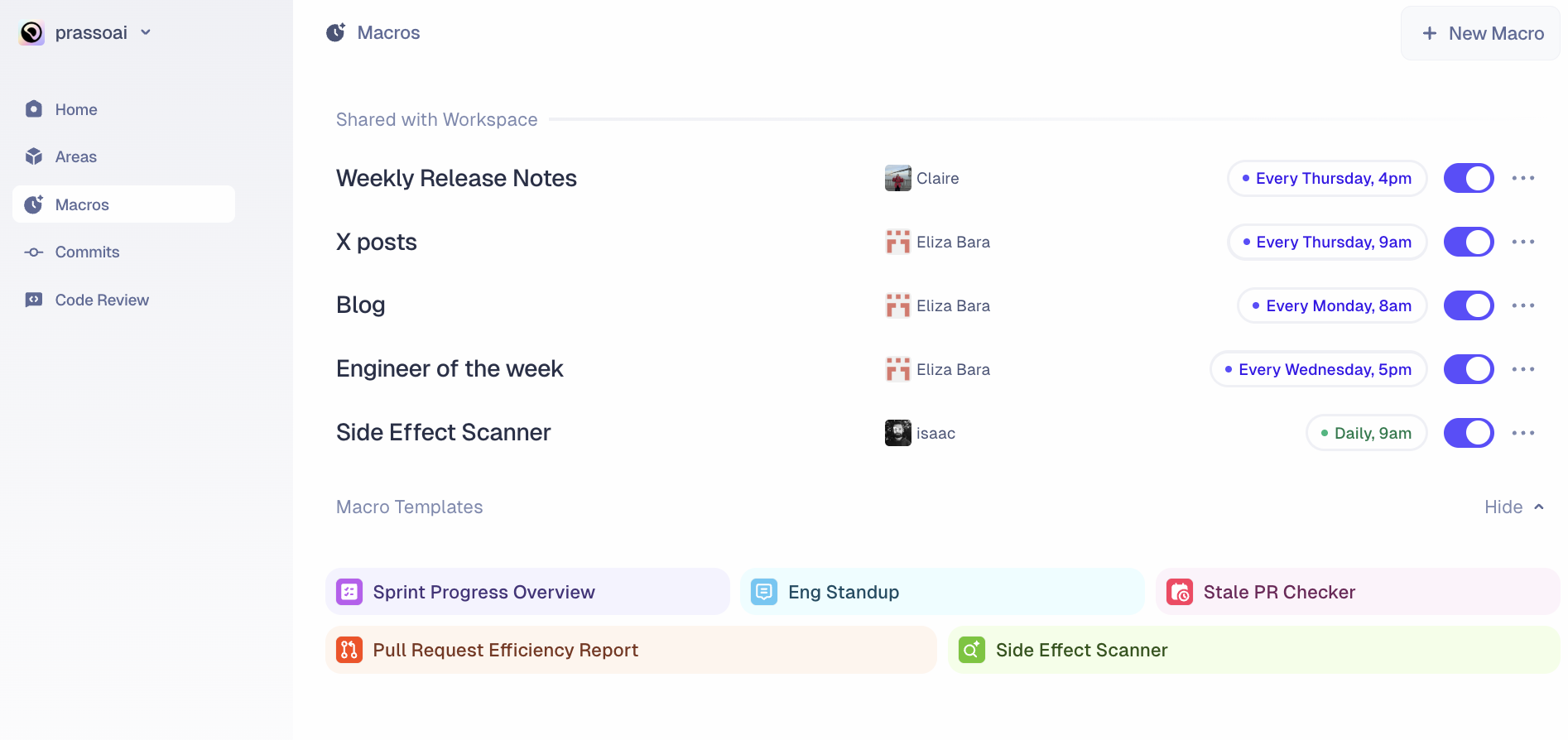
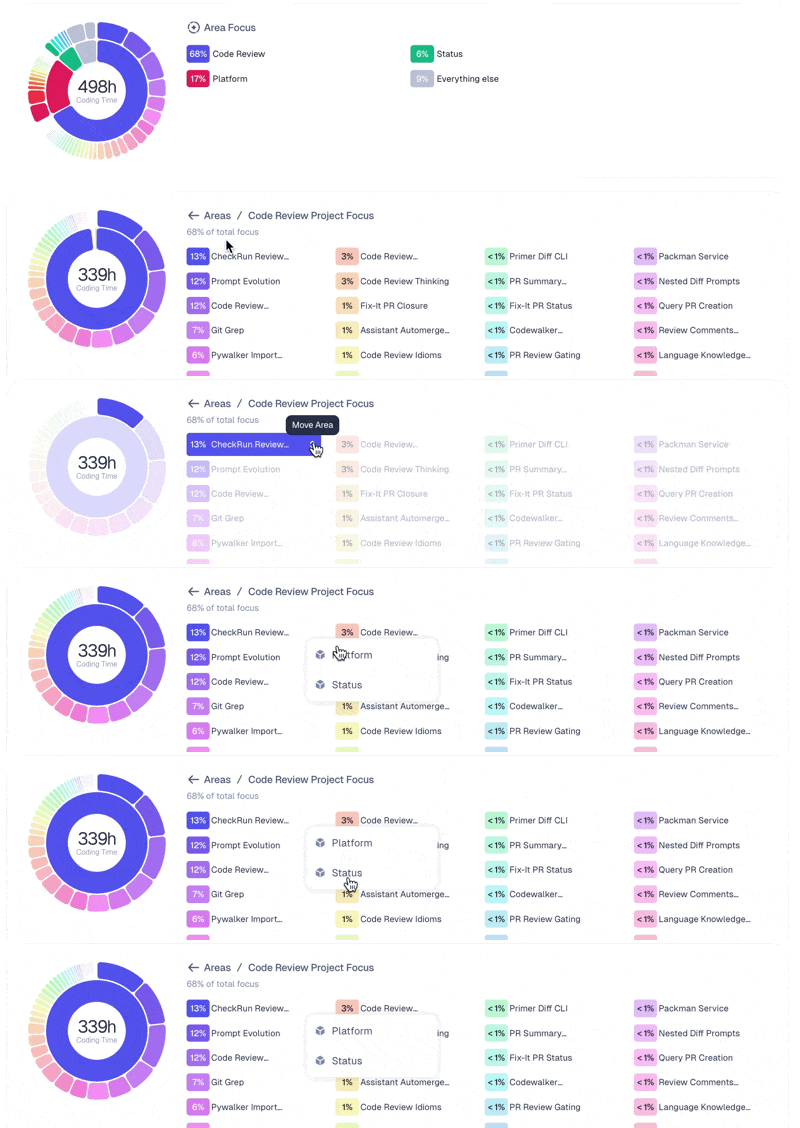
Comment Resolution TrackingCode review comments now link to the commit where they were resolved and indicate if feedback has been addressed. Macroscope automatically evaluates and updates comments when new code is pushed to a PR.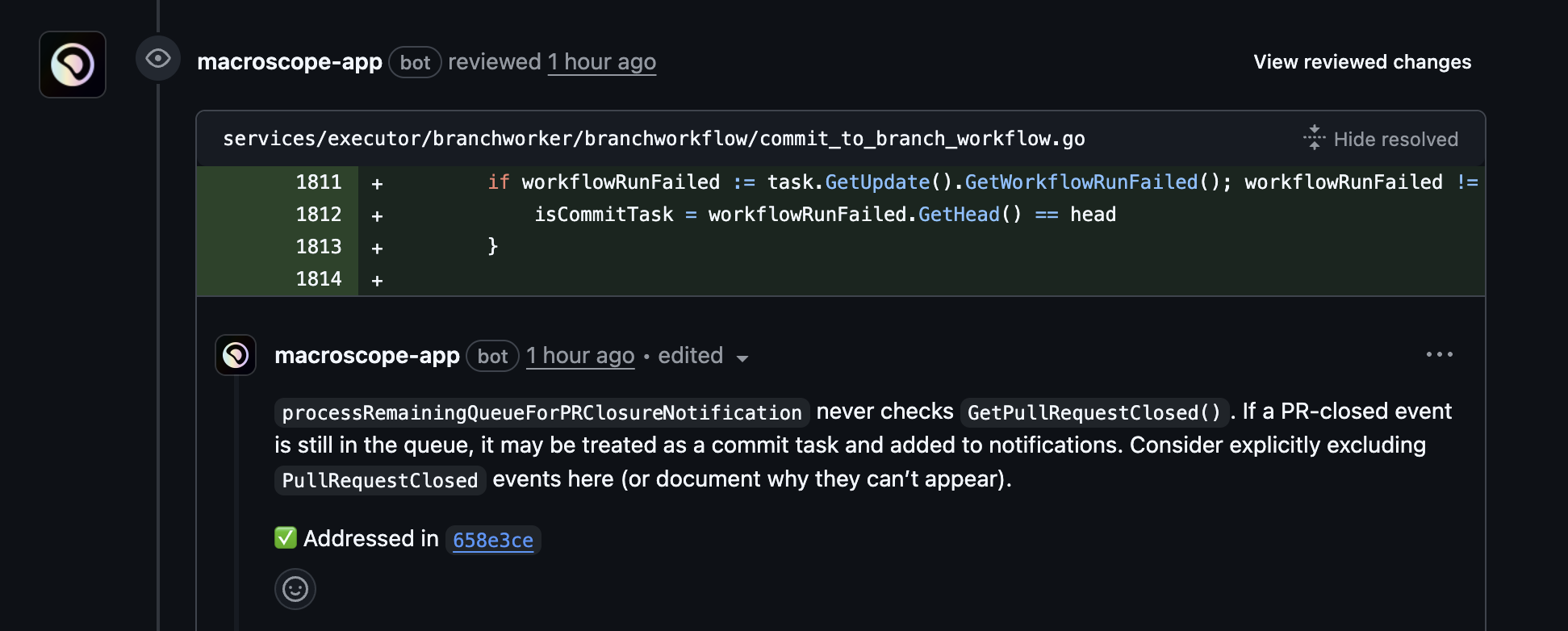
Neutral Check Run StatusWhen Macroscope reviews your code and posts comments with issues that need addressing, check runs now complete with
NEUTRAL status instead of SUCCESS, so it’s clear when there’s pending feedback to address.Explanations for Blocked Auto-MergesWhen you use Macroscope’s coding agent to automatically fix issues on a feature branch, the agent creates a pull request with the fixes and attempts to auto-merge it back to your base branch (if you have auto-merge enabled).If auto-merge is blocked, Macroscope now posts a comment explaining the specific GitHub requirement preventing the merge (e.g. missing reviews, merge conflicts, failed checks).Flexible @Mention Support in GitHubMacroscope now responds to both @macroscope and @macroscope-app.Fix It For MeMacroscope can directly fix issues found during code review. Just reply to a GitHub review comment and ask Macroscope to fix it. Macroscope will create a branch, push commits, open a PR, and merge it back into your working branch. See help docs for more details.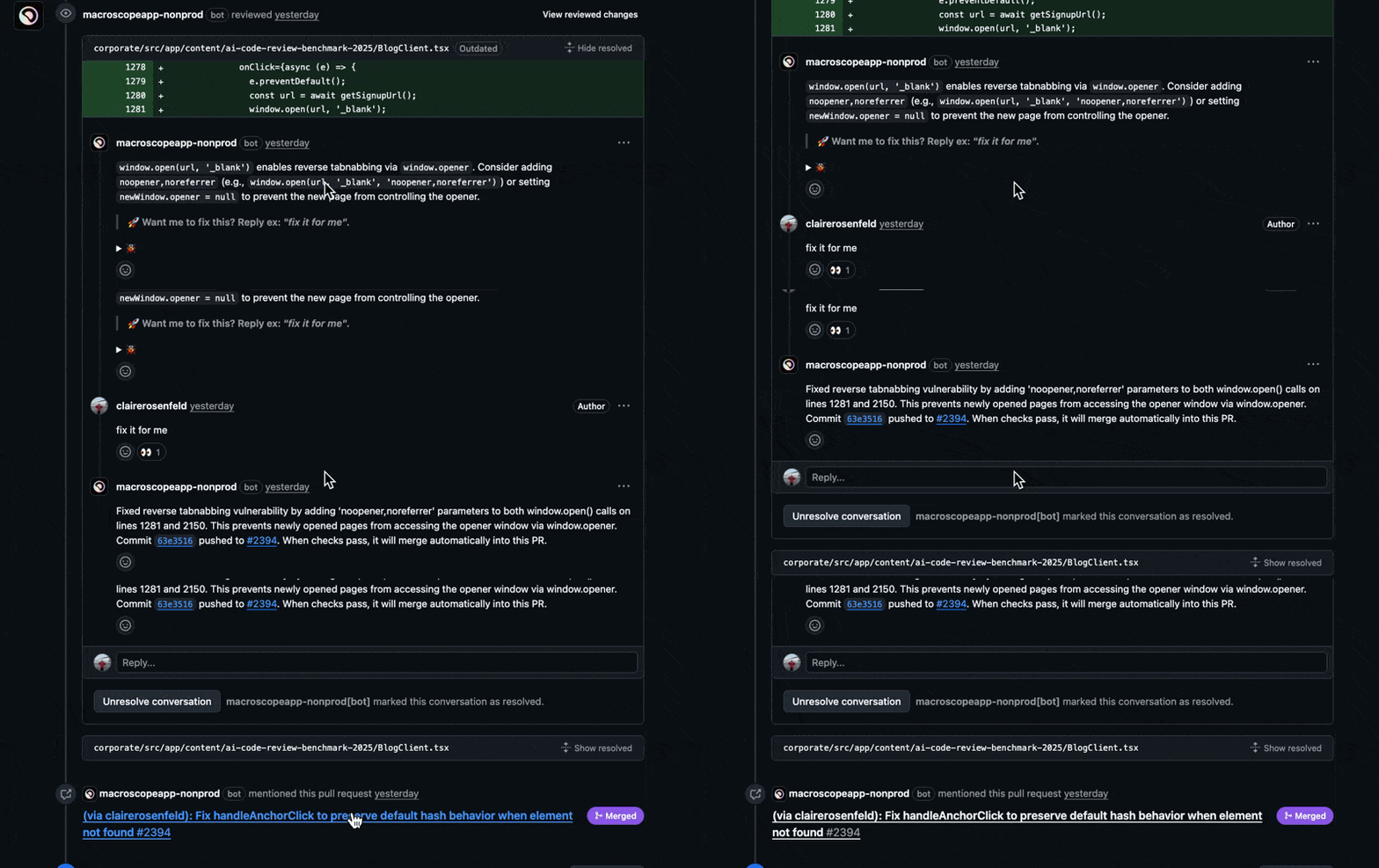
Personal Code Review SettingsIndividuals can now customize their individual preferences for PR Summaries and Code Review that override their workspace defaults. Select “Repo Default” to inherit preferences from the repository level.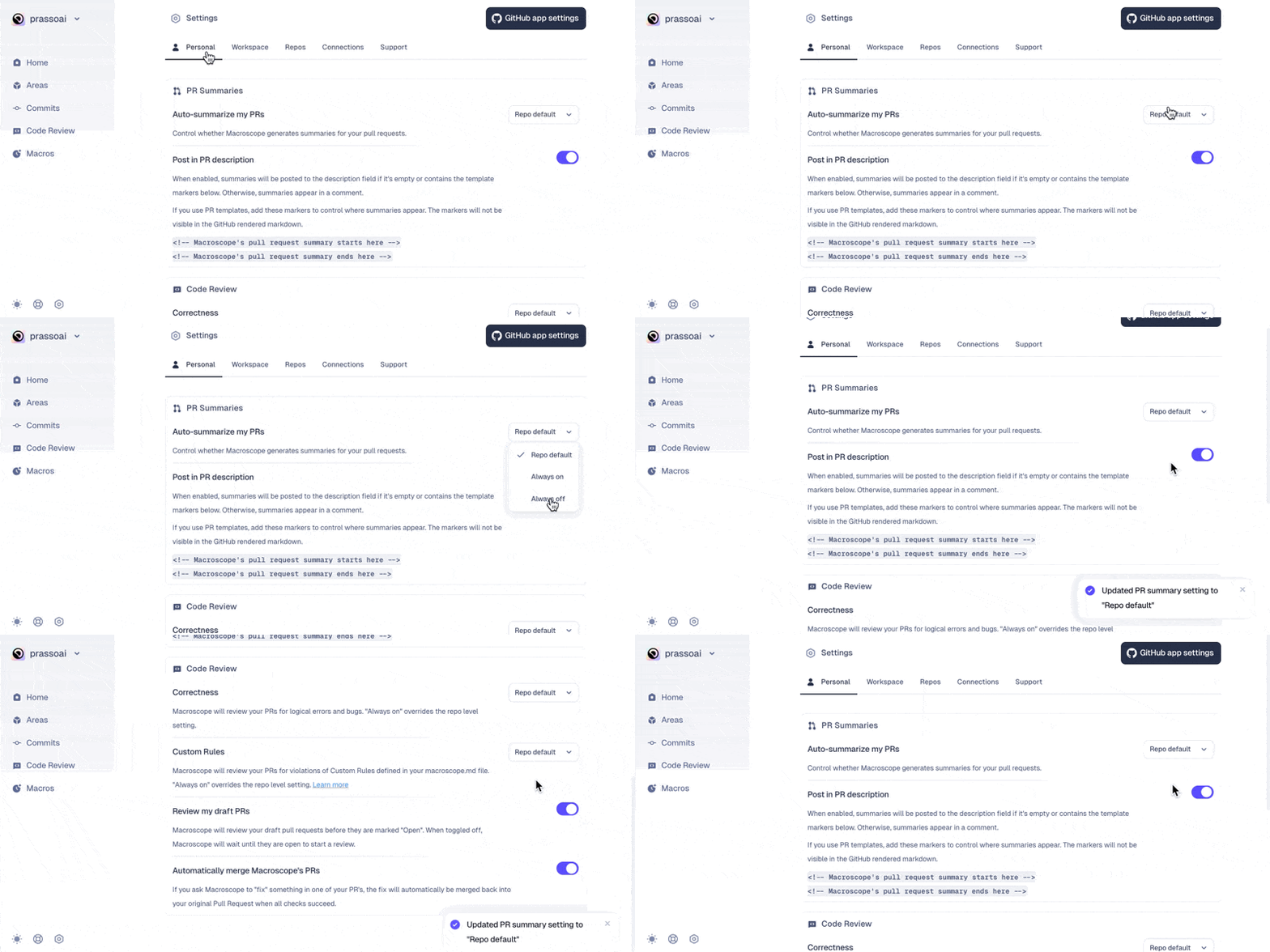
v2 Code Review by Opus 4.5We released a new version of Code Review powered exclusively by Claude Opus 4.5. Compared to our previous code review pipeline, the new pipeline has 40% higher recall and generates 10% fewer false positives. Learn more in our blog post.Invoking Macroscope in PR DiscussionsMacroscope can now respond to your comments in the main PR discussion thread, not just inline code comments. When you mention @macroscope-app in a comment, Macroscope will react with 👀 to acknowledge it’s thinking about your question and then respond in the main discussion thread.Ignoring Bot Comments in GitHub@macroscope-app no longer responds to comments authored by other bots in GitHub.
Improved Executive SummariesWe’ve simplified summaries on the home page. Summaries are organized by Areas and have collapsible sections, so you can easily see a high level view of what’s changed in your codebase this sprint.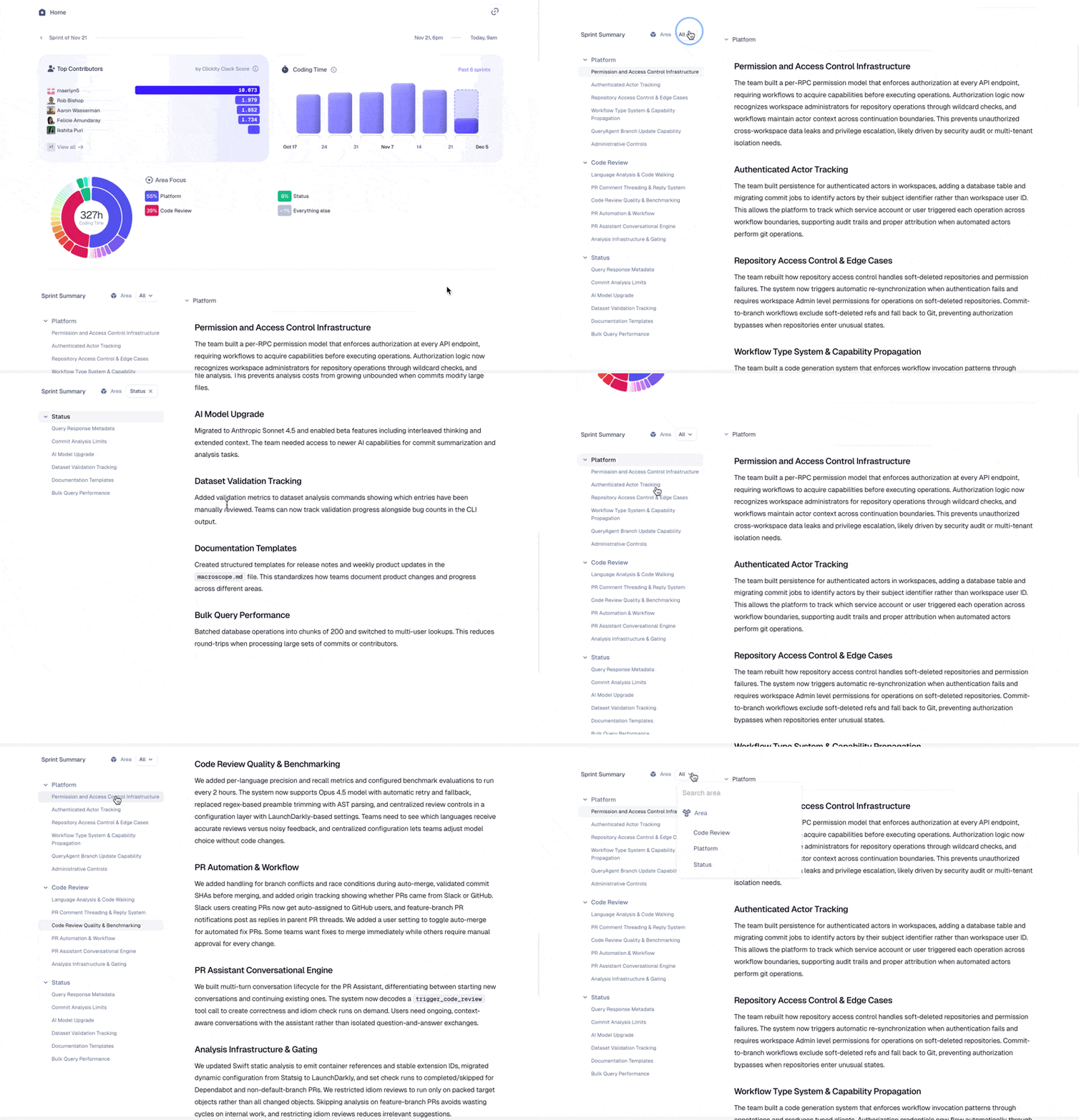
Streamlined Macros SchedulingScheduling regular reports with Macros is now even easier. After you set your daily/weekly cadence and write your prompt, all you need to do is copy/paste the generated Slack command into any Slack channel(s) you want to subscribe to the Macro. Learn more about Macros in our help docs.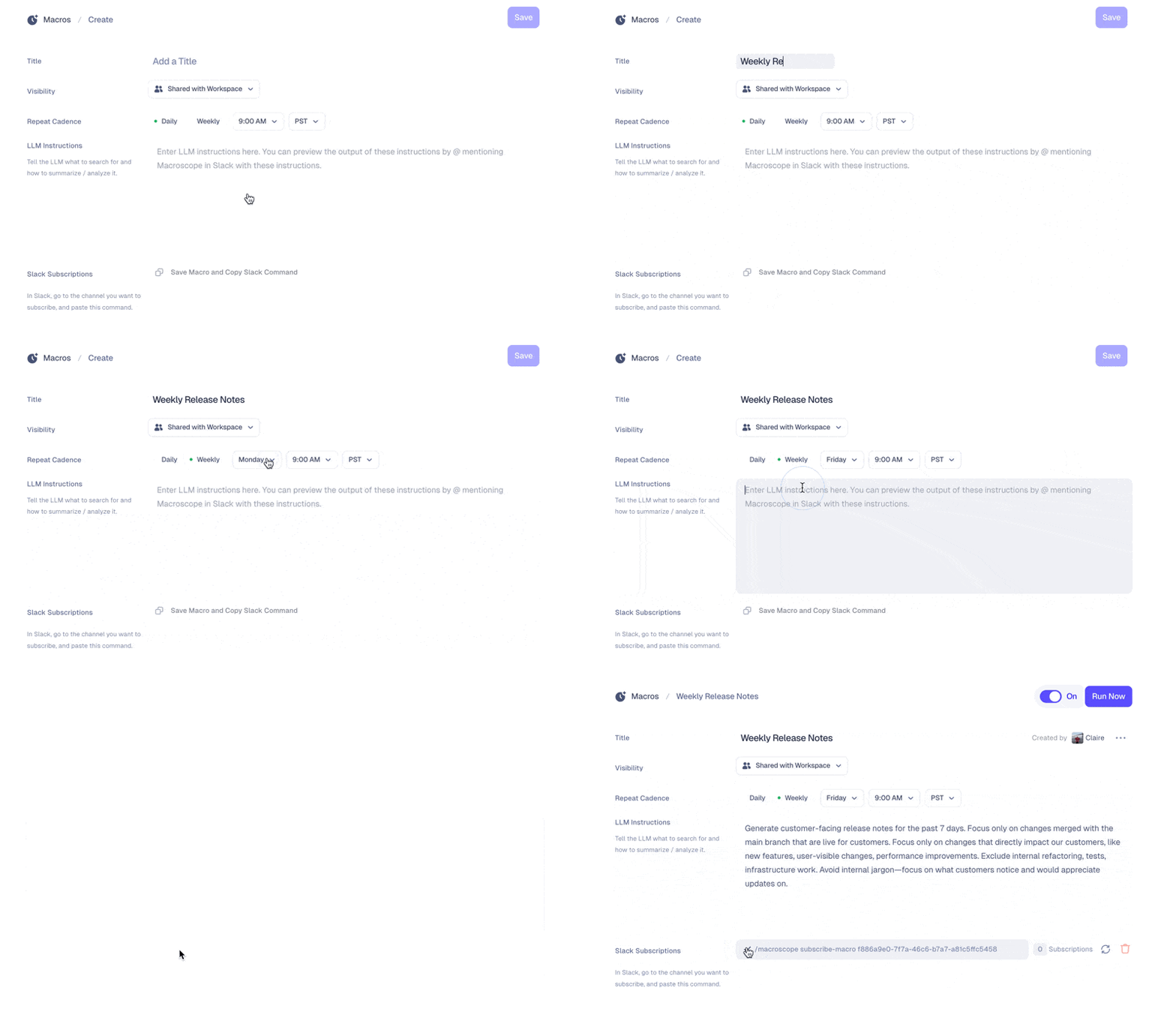
Manually Trigger Code Review in GitHubYou can now manually trigger a code review on a PR in GitHub by commenting 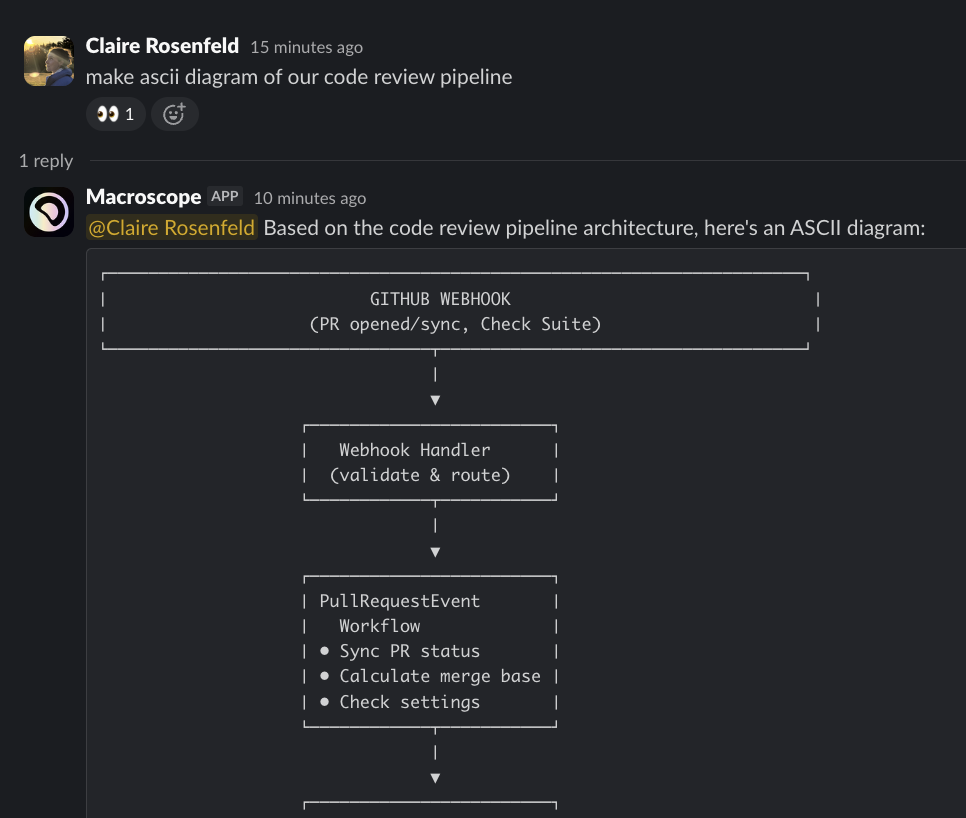
@macroscope-app review, regardless of whether Macroscope code review is enabled for the repository. Macroscope will acknowledge your comment with a thumbs-up reaction and run a code review on the PR. This is useful when you want Macroscope to run another review after making changes, or when automatic reviews are disabled for a repo.Visualize Your Code in SlackWant to see how tables are connected in a database? Map a diagram of a workflow’s lifecycle? You can ask @Macroscope to generate ASCII diagrams of anything related to your code.- Smarter Guidance - Query Agent can provide guidance when you explicitly request help, even for tasks outside its direct capabilities.
- Adaptive Tone - Macroscope adapts to your communication style. If you use humor or casual language, Query Agent will respond in kind while maintaining accurate and factual responses.
- Content for External Stakeholders - When you need content for external audiences, Query Agent can format responses and links appropriately for sharing outside your organization. Just request externally-facing content when preparing materials.
- More Flexibility - Under the hood, Query Agent’s underlying prompt system supports broader interaction patterns, allowing it to handle a wider variety of interactions with users.
Merge Notifications in SlackMacroscope now notifies you in Slack in real-time when commits are merged to release branches. When a merge occurs, Macroscope reacts to the original PR summary message with a 🚀 emoji and posts a reply in the message thread. This works for all merge types, including squash, rebase, and fast-forward merges.Note: this requires subscribing to commit notifications in a Slack channel with the 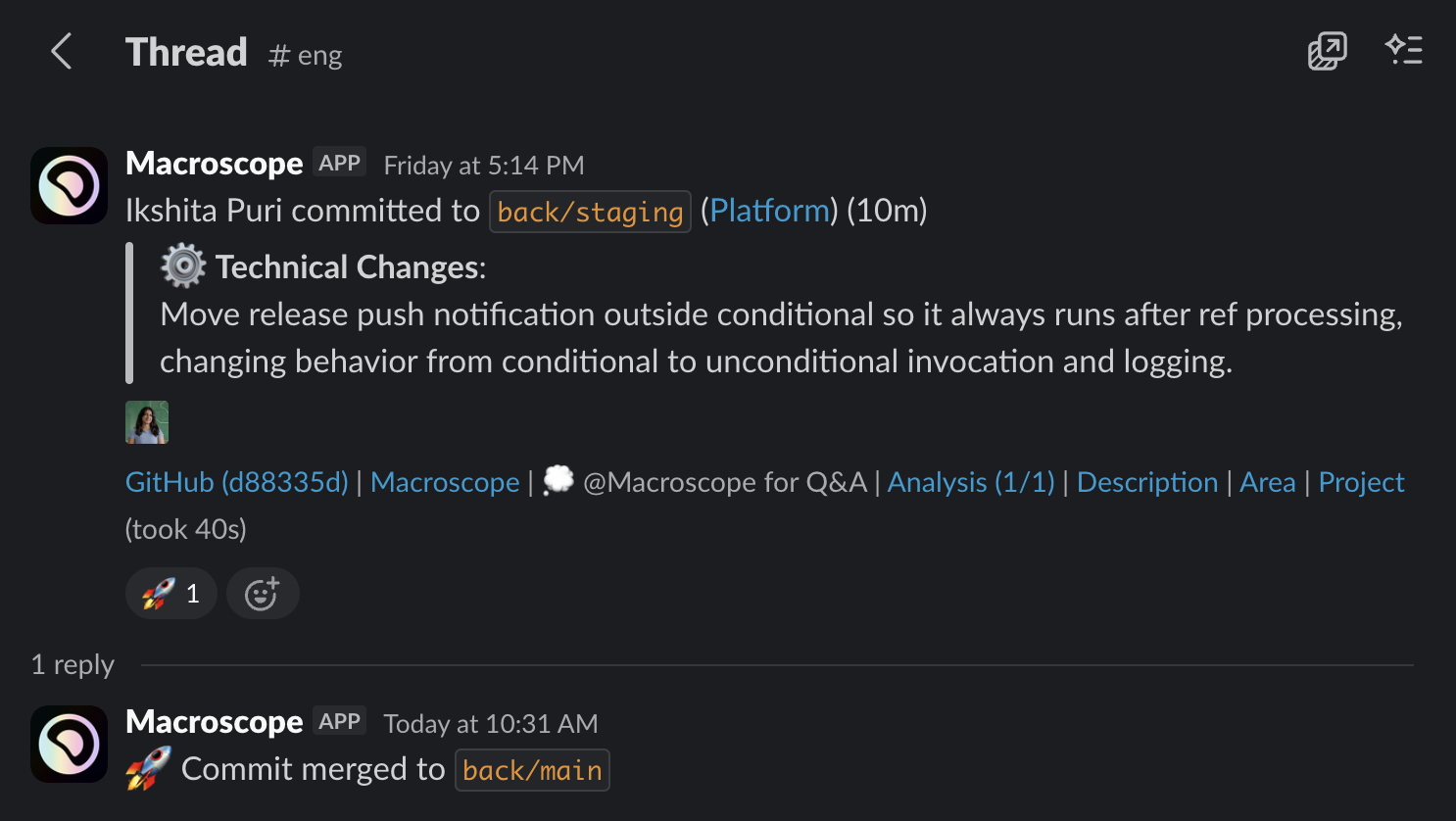
/macroscope subscribe-commits command.- GitHub’s native inline suggestion block (i.e. “accept diff”)
- Unified diff blocks (i.e. static code diff)
- No diff (i.e. text-only explanations)
Batch Repository SettingsYou can now configure settings for multiple repositories at once. The new interface, found in Settings → Repos, allows you to search repos, select multiple repos, and apply settings across multiple repos simultaneously.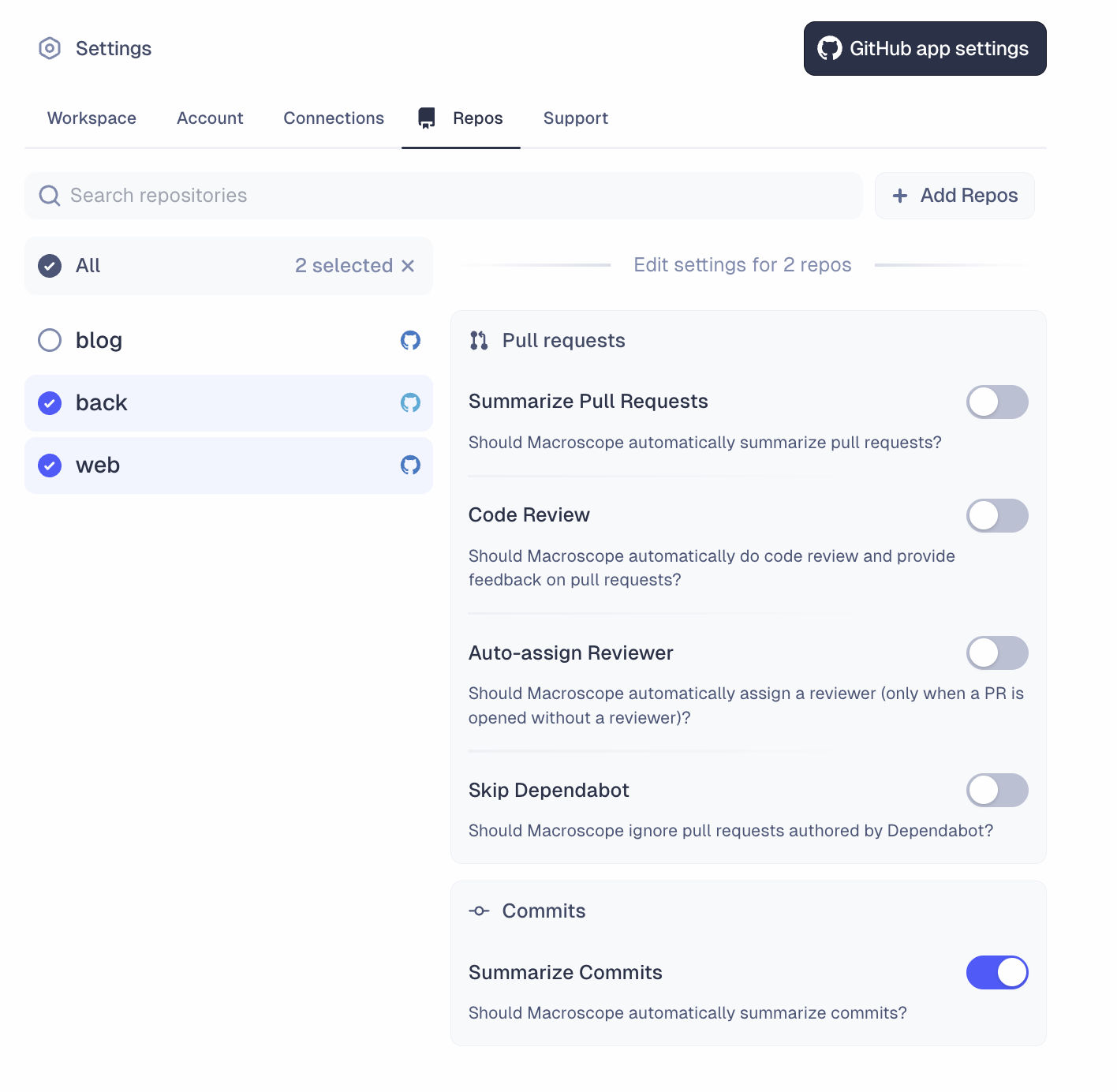
Path-Based Filters for Slack SubscriptionsWith path-based filters, you can limit code activity subscriptions to specific parts of a repository. Any activity that modifies files matching the specified path filter(s) will trigger a Slack notification in the subscribed Slack channel. To create a code activity subscription that is filtered by file path, add the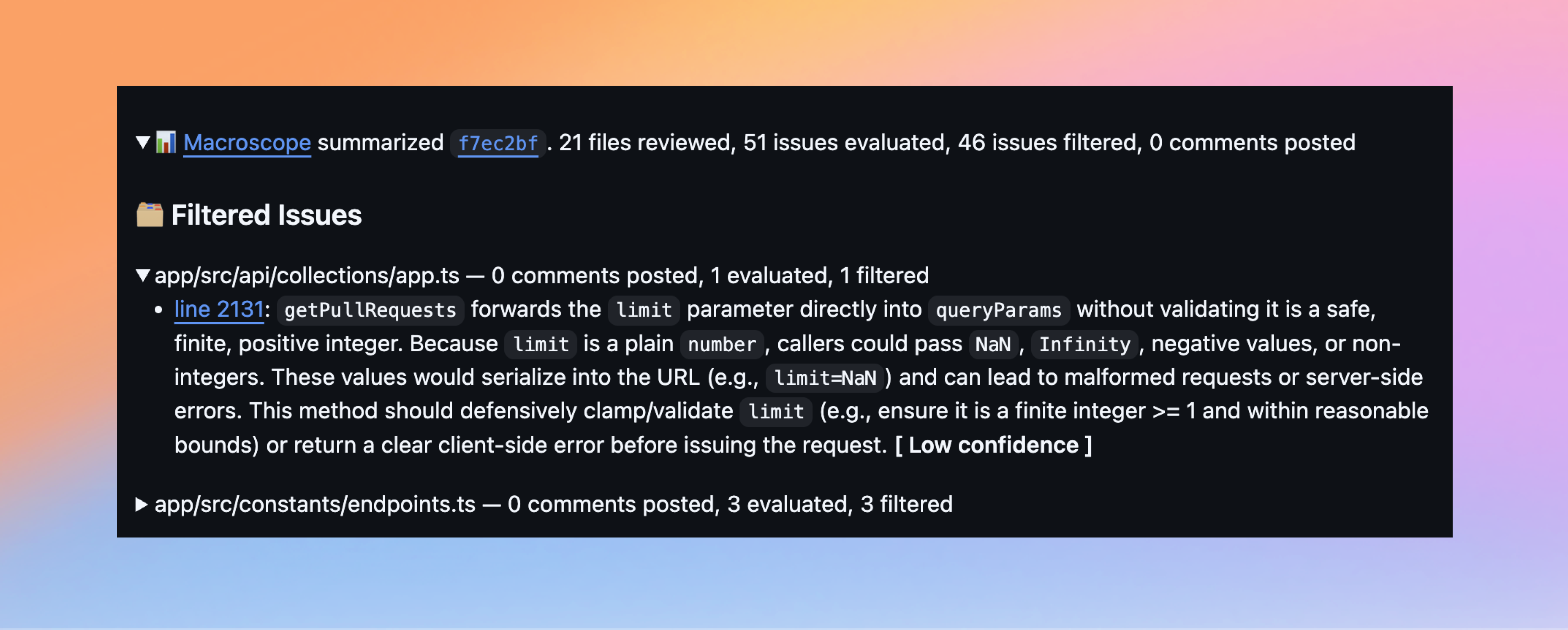
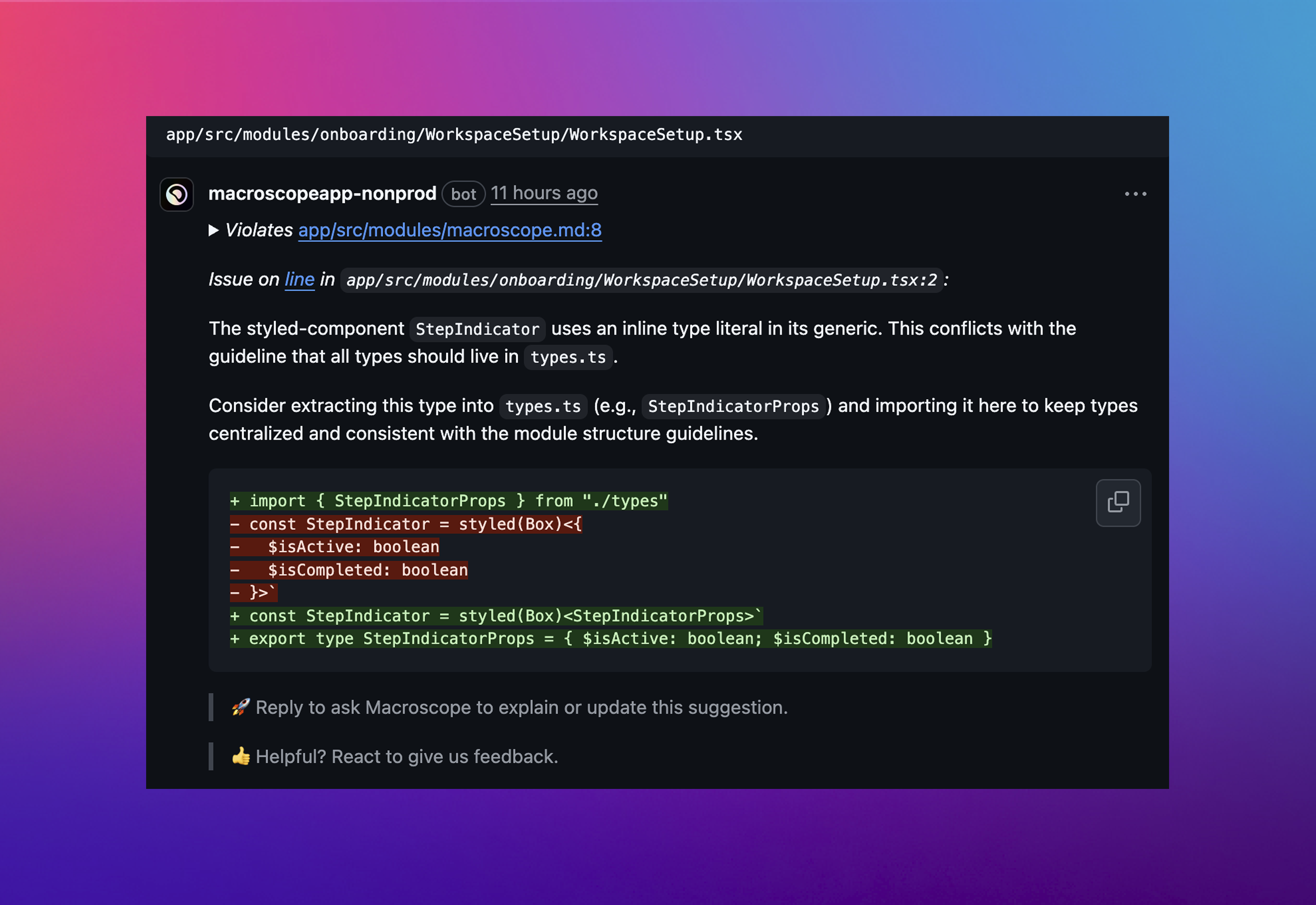
--paths= flag to the end of a /macroscope subscription command, and specify which file path(s) you want to filter by. Learn more about path-based filters in our help docs.Filtered Issues in Code ReviewIf you’ve been curious which comments Macroscope considered leaving on your pull request but didn’t, you can now see them. By default, these lower-signal comments are hidden to keep reviews focused. However, you can expand the “Filtered Issues” section at the bottom of the PR description to see which comments were excluded, by file, and expand each file to view the specific comment(s) identified.macroscope.md files throughout your codebase, you can define your team’s best practices (i.e. anything that’s idiomatic of how you want code to be written). During reviews, Macroscope will run a separate CheckRun that flags violations and leaves inline comments that reference the relevant rule.AI Web Research in Code ReviewCode review now has web research capabilities, meaning that Macroscope can search the web for external knowledge sources. When reviewing your code, Macroscope uses Parallel’s search API to find the latest documentation, so that code reviews take into account every library and package you use.
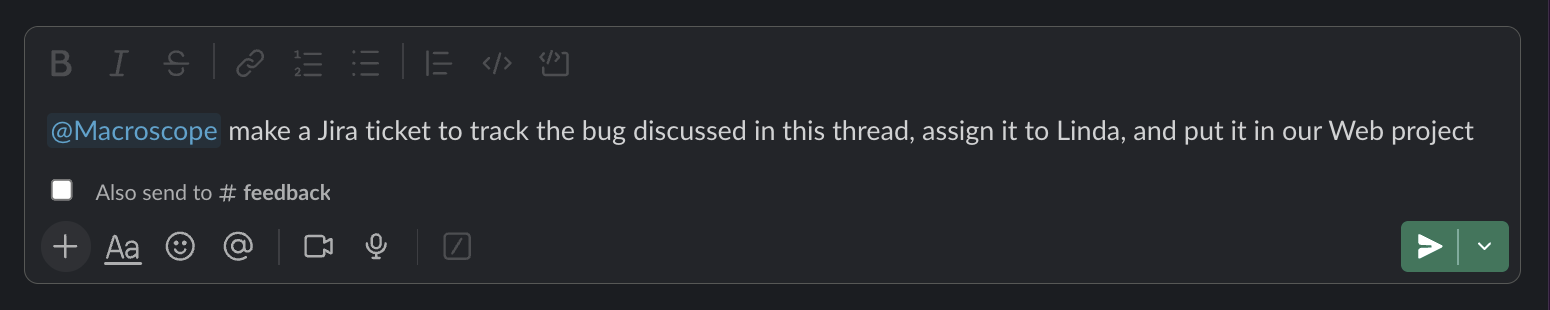
Contributor Metrics in AMAMacroscope AMA now has access to Contributor Productivity Metrics (e.g. # commits, # PR, coding time), so you can ask questions like “@Macroscope how many PRs were opened in the last 2 days?”. Macroscope’s agent can retrieve any metrics that are visible on the Macroscope website, across any time range.Linear Integration v2Macroscope is now using Linear’s new “Agents” framework. Soon, Macroscope will be able to take actions on behalf of users in Linear. Existing customers will need to unlink and re-link their Linear application in their Macroscope settings in order to authorize fresh permissions.Jira Integration v2We are building a deeper Jira integration in Macroscope AMA. Soon, Macroscope will be able to create Jira issues and answer questions about your Jira projects and issues.Squash Merge SummariesThe Commits page now displays summaries for squash merges. Users can hover over a branch’s release details to view the summary, which shows the number of commits squashed and the date range covered.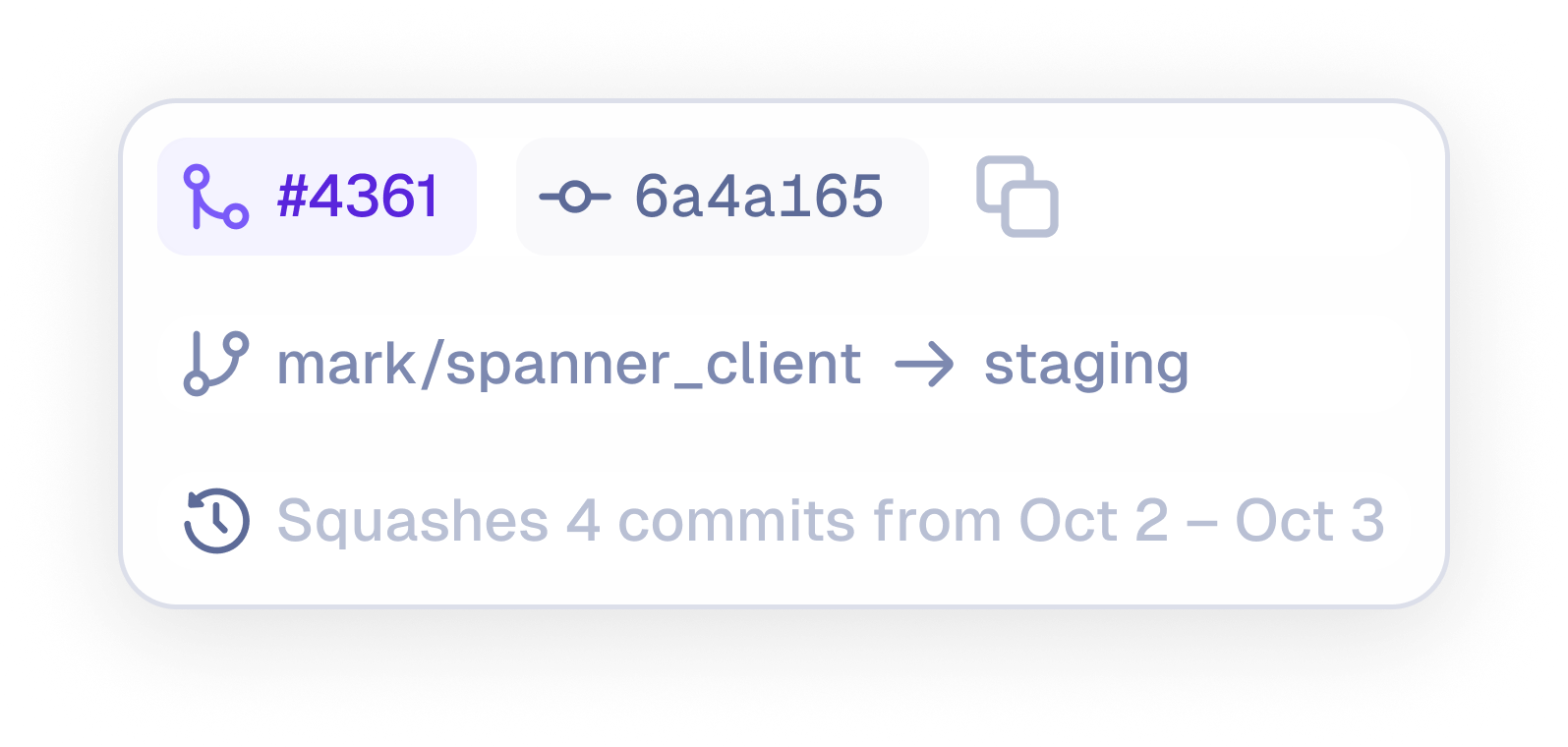
Support for GitHub PR TemplatesYou can now add Macroscope summaries directly into a PR template by placing special markers where you want the summary to appear. Learn more in our help center.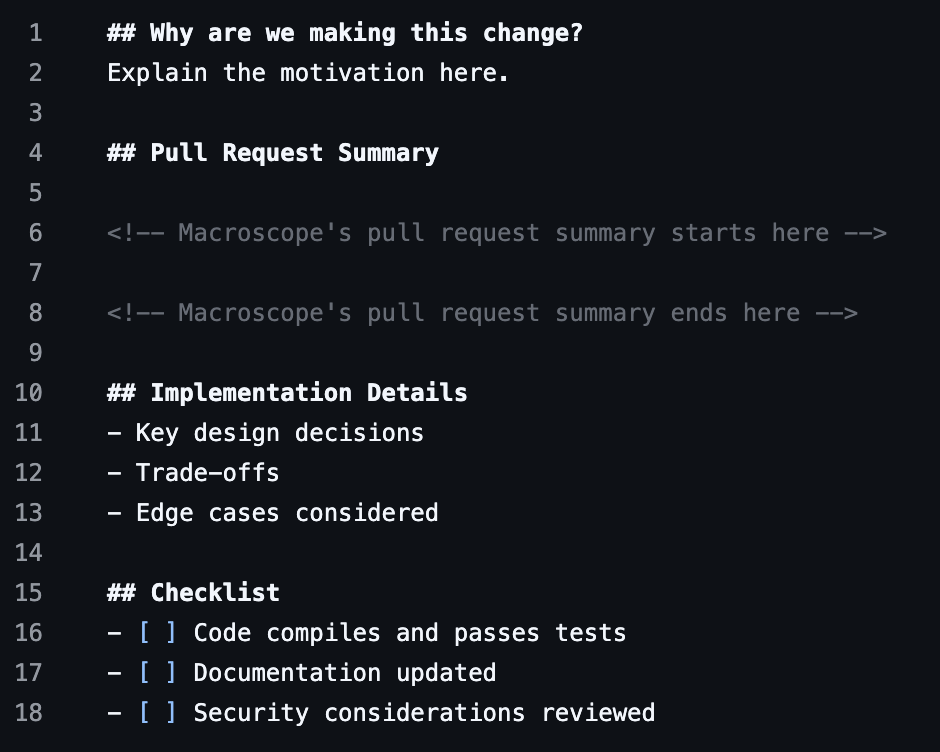

We’re Live!As of September 17, we’re officially out of private beta.Coding Time EstimatesImproved our Coding Time estimate algorithm to provide more accurate estimations based on the complexity of code changes.Code Review ImprovementsOptimized our code review pipeline to reduce the likelihood of false positives. In our testing, this results in ~30% lower comment volume without a meaningful impact to overall bug detection rate.Deployment Tracking for Commits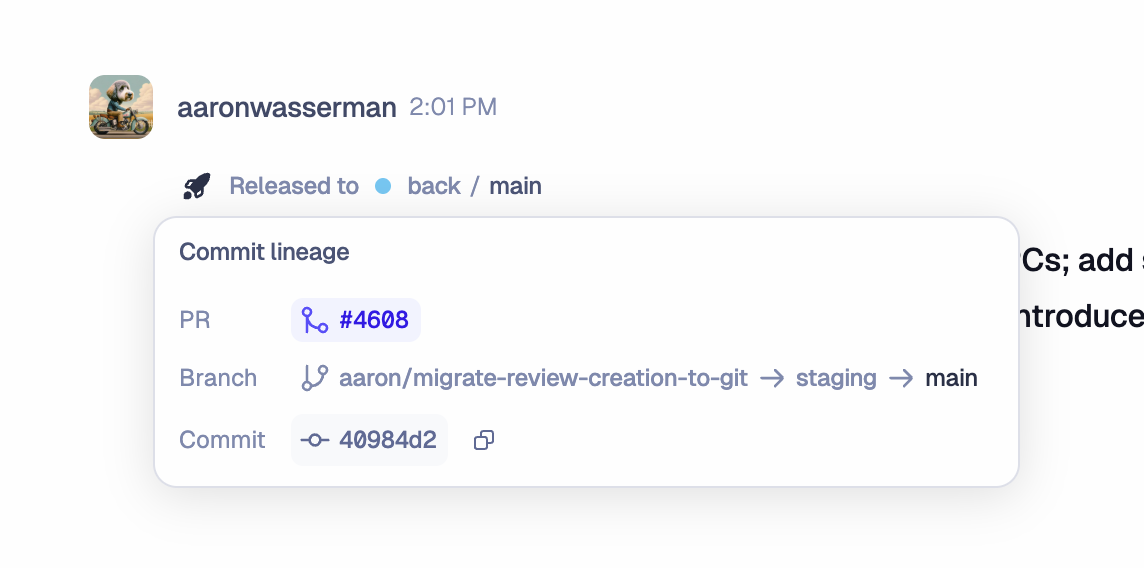
Code Review ImprovementsImproved bug detection across the 8 languages Macroscope code review supports. Our new pipeline will identify many more potential issues than before. In testing, we observed a significant improvement in detection rates with only a marginal increase in disapproval rates.Status for “Run Now” MacrosWhen clicked, the “Run Now” button on the Macros Page shows live status, so users know when a Macro is executing and that the results will be posted to Slack soon.Project Focus Breakdown Chart TooltipsTooltips in the Project Focus Breakdown chart on the Productivity Page have been improved for readability.
Account Settings Code Review ToggleUsers now have the flexibility to turn off correctness code reviews for their own PRs at the account level. This toggle is available in Settings → Account and gives each user more control over their review experience.Mobile Experience ImprovementsImproved scrolling behavior and updated UI for a smoother, more consistent experience on mobile.